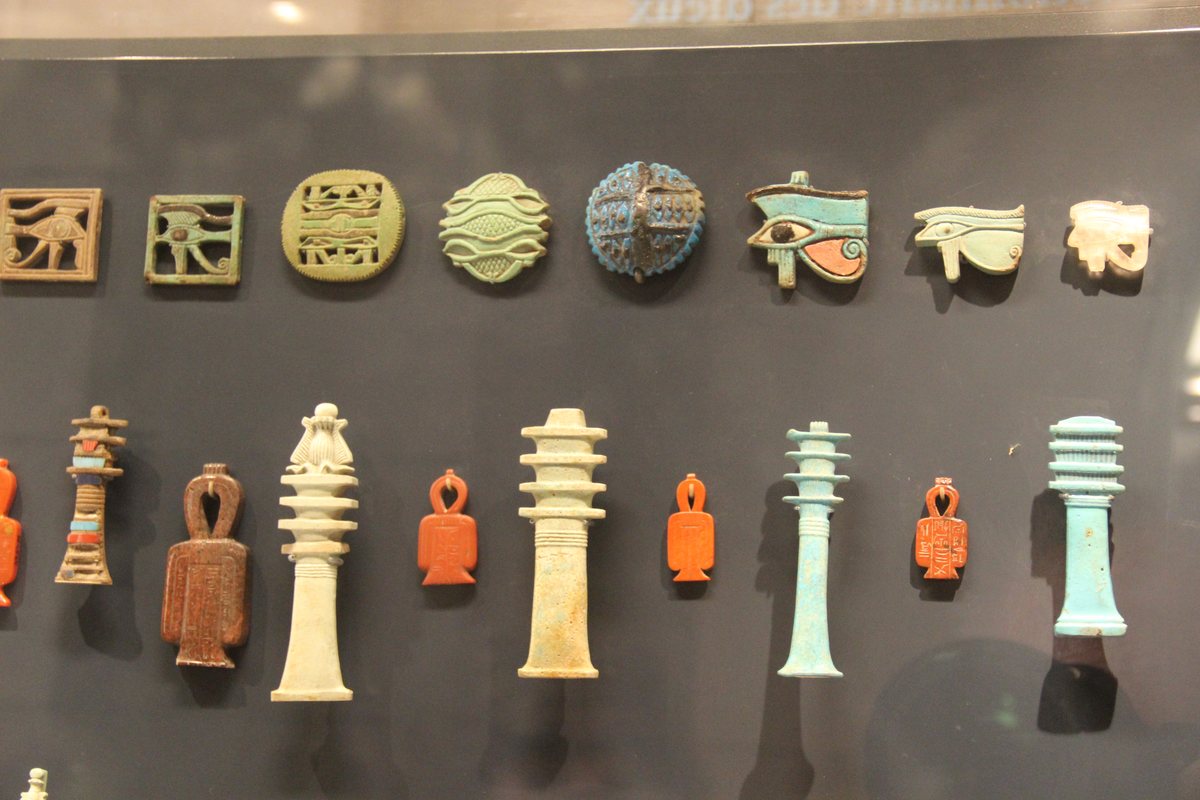
Egyptian faience is a silica-rich glazed material, not glazed clay in the ordinary ceramic sense. Glass is compositionally and technically distinct, though both can place intense colour, light and controlled heat at the centre of interpretation. Small beads, tiles, vessels and amulets carry evidence for recipes, workshops, exchange and repetition. Begin with material identification, then ask how the surface and body were made to work together.
Do not collapse the categories
Faience, glass, frit, glazed stone and glazed pottery may look related in a case, especially under cool lighting. Their bodies and production sequences differ. Use the label’s material field and retain uncertainty where it appears. A broken edge can expose body colour and thickness, but visual inspection alone may not settle composition. Museum catalogues and scientific studies are better guides than a visitor’s colour match.
Read body and glaze together
On faience, a bright glazed surface covers a silica-rich body that may be pale, granular or differently coloured. Cracks, worn corners and ancient breaks sometimes reveal the relationship. Glaze formation can involve different application or efflorescence processes, and confident identification requires study. Describe whether colour pools in recesses, thins on edges or varies across a group before proposing a technical explanation.
Use repetition to find production
Rows of beads, amulets or tiles suggest moulds, standardized dimensions and organized firing, but no two pieces need be identical. Compare outline, hole position, glaze coverage and colour variation. Repetition can reveal production targets while irregularities record handling of paste, mould, drying and kiln conditions. Count only what the case makes visible; an exhibition group may be a selection rather than a complete archaeological batch.
Treat colour as chemistry and culture
Copper compounds can contribute blue and green hues, while other colorants and firing conditions expand the palette. Material cause does not exhaust cultural meaning. Colour associations change by object, period and context, so avoid a universal code in which every blue item means the same thing. Combine composition, inscription, form and findspot. A technical fact and a symbolic interpretation answer different questions and require different evidence.
Notice light as an active condition
Transparent, translucent and glossy surfaces respond dramatically to case lighting. Move your viewpoint to observe transmitted and reflected light without blocking others. The current effect may differ from ancient daylight, lamplight or architectural placement. Photographing through glass can intensify colour and reflections, so do not use a phone image as a neutral colour record. Include gallery lighting in your observation notes.
Look for heat without inventing a kiln
Bubbles, deformation, glaze variation and joining can point toward high-temperature processes, but they do not reconstruct a specific workshop on their own. Archaeological kilns, waste, tools and unfinished products are stronger contextual evidence. When a museum connects an object to a production site, copy that source. Otherwise frame your workshop sequence as a technical question, not as a witnessed scene.
Make a colour-control sheet
Choose three neighbouring objects. Record labelled material, body colour, surface colour, translucency, repeated form, edge variation and the lighting that affects your view. Add one contextual fact for each. The sheet turns a bright display into a comparison of controlled variables and prevents the most saturated piece from becoming automatically the most important or technologically advanced.
Use the damaged piece as a technical section
A chip or ancient break can reveal body, wall thickness, glaze boundary and internal colour more clearly than a perfect face. Observe it through the case without treating damage as fortunate or requesting a closer view. Compare the broken section with the institution’s material identification. One fracture cannot provide a complete recipe, but it can show which visible qualities belong to surface, body or transmitted light.
Touch nothing. Preserve uncertainty. Record the inventory number, museum and observation date. Confirm visitor rules with the institution.
Institutional sources reviewed 29 July 2026: Egyptian Museum ↗ · Petrie Museum ↗. Collection records and displays may change.