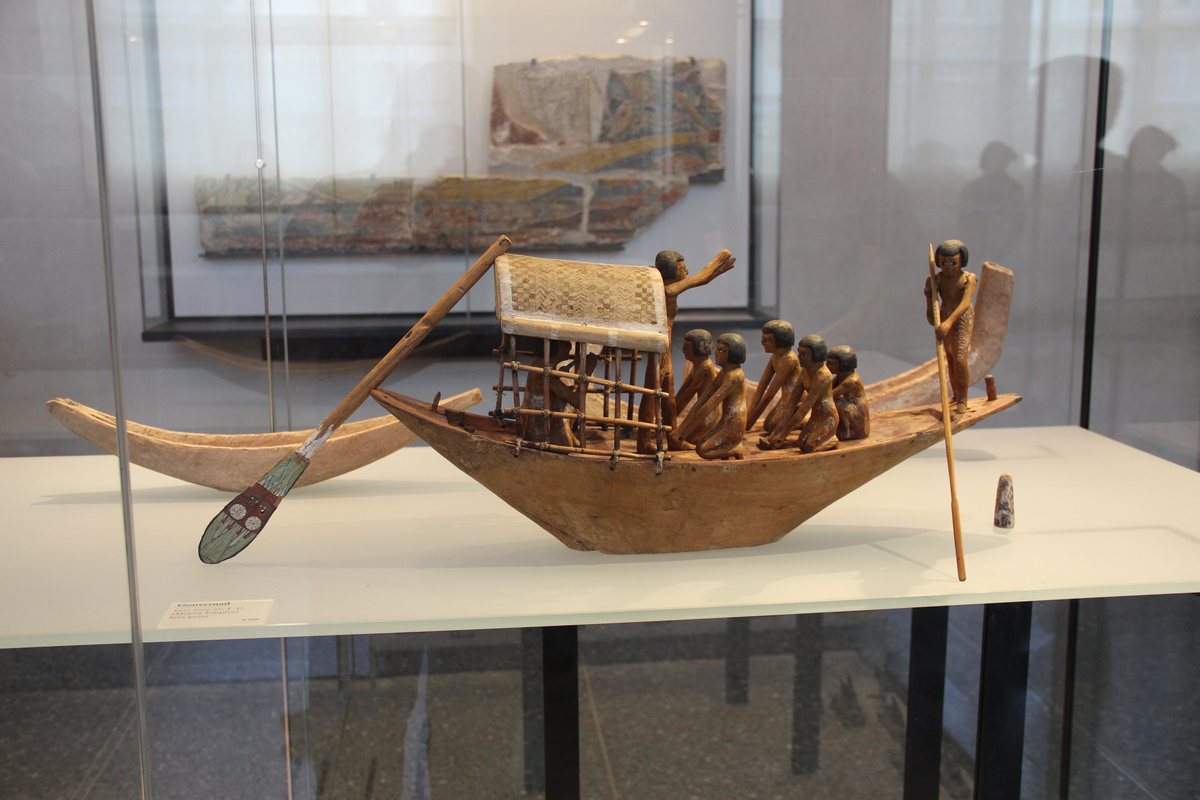
Wooden objects often survive in Egypt because particular burial environments slowed biological decay, not because wood was ordinarily permanent. A model, coffin, box or piece of furniture is therefore both an ancient construction and an exceptional survivor. Its grain, joins, added surface and repairs reveal choices that a polished case can make easy to miss. Read it as assembled material rather than as a single carved volume.
Begin with survival conditions
Ask where the object was found and whether the institution explains its burial environment. Dry, stable conditions can preserve wood, fibres and coatings that would disappear elsewhere. Survival creates a powerful bias: an excavated object from a protected tomb cannot represent every wooden thing once used in settlements, workshops or river transport. Record preservation as part of the evidence before drawing broad conclusions about daily life.
Follow the grain
Grain direction affects strength, splitting and the size of available parts. Compare long structural members with smaller carved additions. Knots, checks and warped edges can show how the material behaved after cutting and during burial. Species identification may require microscopy, so do not name a tree from colour alone. If a label identifies local or imported wood, preserve the wording and look for the study behind that claim.
Map every join
Mortise-and-tenon joints, dowels, pegs, lashings and adhesive lines distribute loads and let makers combine smaller pieces. Trace where a hull, chair, coffin or model changes direction. A joint can be original, an ancient repair or a modern conservation intervention; the museum may distinguish them through diagrams or subtle fill materials. Draw the construction as connected parts. This immediately makes planning and collaborative labour easier to see.
Look through the surface
Paint, plaster, varnish, gilding and inlay can hide the wooden core while transforming its meaning and value. Losses sometimes expose preparation layers, but those vulnerable edges are not invitations to lean closer than the barrier allows. Note the order of visible layers and whether decoration crosses joints. A coherent painted scene may have been planned after assembly, while separately decorated parts can suggest a different workflow.
Make repairs part of use
A replacement peg, patched split, added brace or worn contact point can document maintenance. Repair is evidence that an object remained useful or meaningful enough to keep. It may also change balance and appearance. Avoid calling every irregularity ancient: excavation teams and conservators have also reconstructed wooden objects. Label wording, photographs and treatment records help separate original manufacture, ancient maintenance and modern stabilization.
Question the miniature
Wooden models are not neutral photographs of boats, workshops or food production. Scale, selection and funerary context shape what they show. Figures may simplify action while preserving useful information about tools, roles and sequences. Compare several models and archaeological evidence before treating one detail as an everyday norm. Ask what activity is emphasized, who is omitted and how the model’s intended setting changed its design.
Build an assembly note
Choose one object and list its parts from structural core to final surface: board, peg, plaster, pigment, inlay, repair and mount, as appropriate. Connect each part to a visible observation or museum statement. Then mark what is hidden. This assembly note resists the illusion that the museum object appeared whole in one moment and makes later conservation support legible without confusing it with ancient craft.
Use absence as a structural clue
Missing arms, rigging, lids or inlays can expose sockets and attachment points that a complete object would hide. Describe the empty join before reconstructing its lost part. A comparison may suggest the original element, but scale and date must match. The gap also records burial, excavation or treatment history. It is evidence for construction and change, not simply a defect that a digital reconstruction should erase.
Touch nothing. Preserve uncertainty. Record the inventory number, museum and observation date. Confirm visitor rules with the institution.
Institutional sources reviewed 29 July 2026: Egyptian Museum ↗ · Grand Egyptian Museum ↗. Collection records and displays may change.